
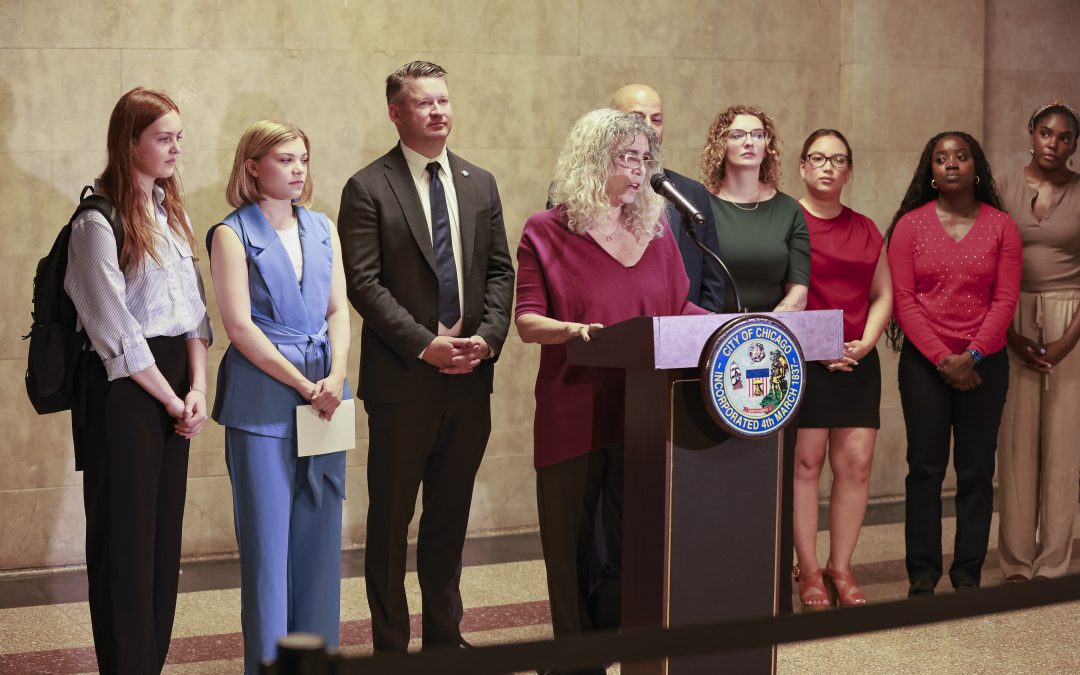
On June 18, 2025, Chicago Alderman Bill Conway held a press conference at city hall highlighting the harms smoking on the CTA brings to the community. Currently, smoking of any form and vaping is illegal on CTA and CTA property. While the policy is in place, issues stem from a lack of enforcement and social pressure for those who choose to light up on transit.
RHA’s Senior Director of Strategy, Programs, and Policy, Erica Salem spoke, highlighting how smoking impacts those with respiratory illnesses, such as asthma. “When people smoke on the CTA, they are putting at risk the health of all riders, especially those living with asthma and other lung diseases,” Salem said.
Mia Fritsch-Anderson, long time RHA advocate and volunteer, also gave comment. As a Chicago student who regularly takes the CTA, she talked about how her asthma was often aggravated from individuals smoking on the CTA. Often, she is forced to move cars to avoid the smoke and must preemptively use her inhaler just for the trip to avoid an asthma attack.
The latest available CTA data show that K-12 student ridership on CTA averages 68,000 daily rides on weekdays. Additionally, college students, using the CTA’s U-Pass program, have an average weekday ridership reaching 65,000. Considering the length of the school year, that’s more than 14 million rides a year, or 14 million potential exposures to second-hand smoke to young people in Chicago.
Alderman Andre Vasquez and Alderman Ruth Cruz also spoke, supporting Conway on the measure and calling for higher enforcement.
When people ignore the law and smoke on the CTA, they are putting at risk the health of all Chicagoans, but particularly those living with asthma, and a host of other lung diseases.
- Second-hand smoke is the smoke that individuals breathe when they are located in the same airspace as smokers, like on a bus on train. It is a combination of more than 4,000 chemicals, many of which are known to cause cancer.
- Secondhand smoke is a known trigger for asthma attacks in both adults and children. It contains many harmful chemicals that can irritate the airways and cause them to narrow, leading to difficulty breathing, coughing, wheezing, and chest tightness.
- Studies conducted by the National Institutes of Health have found that people exposed to secondhand smoke while using transportation reported frequent symptoms such as cough, wheezing, or chest tightness, requiring extra medication use.
- We also know that smoke-free laws, which include public transport bans, are associated with a reduction in asthma symptoms and a decrease in emergency room visits for asthma exacerbations.
- And research shows that children with asthma who are exposed to secondhand smoke are more likely to be hospitalized, visit the emergency department, and have lower lung function.
- Beyond asthma, secondhand smoke causes about 3,000 deaths from lung cancer and tens of thousands of deaths from heart disease to nonsmoking adults in the United States each year.
Recent Comments